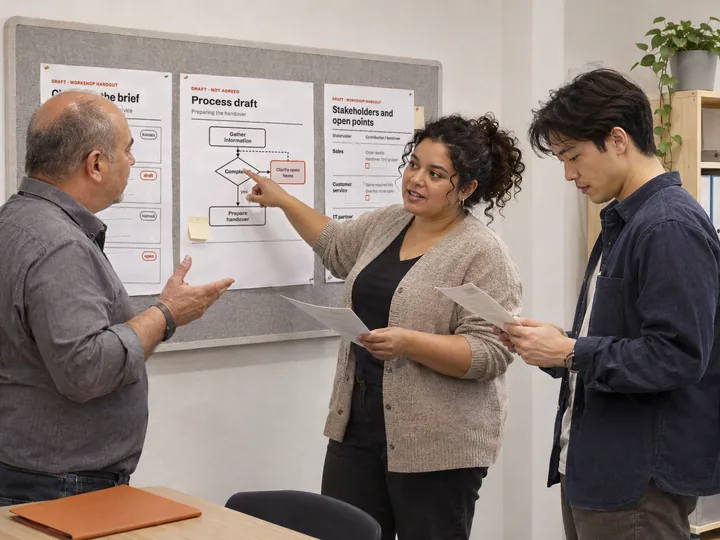
A specialist explains a process to two colleagues at a board.

Practical training · Project management and AI

Turn an idea into a clear brief. Structured with AI, decided by people.

Clarify goals, boundaries and open questions early. AI helps to organise; people have to decide.

One practical day in Zurich · CHF 890 per person, excl. VAT · first sessions planned for the first quarter of 2027

What would you like to do better in your work with AI?

For specialists, project managers and people in PMOs, with or without project management training.

You organise a new process, coordinate a customer assignment or introduce a change. You want to bring goals, people and next steps together clearly. In the training: turning an idea into a clear brief.

Three practice cases from everyday project work

Companies, names and figures are fictional. The cases show how the training works: AI drafts from the sources, people review and decide.

Clarify an initiative: handover from sales to customer service

Fictional practice case: a request, an error log and the IT partner’s feedback become a project profile for clarification.

Situation

A fictional building services SME with around 60 employees sells maintenance contracts. Once signed, customer service takes over. Customer details are partly in the CRM, partly in sales e-mails. Information is regularly missing at handover; an external IT partner looks after the CRM.

Source material

Source 1 · E-mail from the head of customer service
«With new maintenance contracts we often lack the on-site contact, access arrangements and agreed start date. We then have to call the customer. Please suggest how we can improve the handover. Ideally we would start from spring.»
Source 2 · Extract from the customer service error log, last four weeks
«23 new contracts. 9 without an on-site contact, 5 without a start date. The details were mostly in sales e-mails, not in the CRM.»
Source 3 · Feedback from the IT partner
«Mandatory fields in the CRM form are possible. Automatically transferring details from e-mails is not part of the current support contract and would have to be quoted separately.»

Task for the AI

Create a project profile for clarification from the three sources. Separate documented facts from assumptions and cite the source for each statement. Do not invent costs, dates or responsibilities; mark anything missing as open.

Result: project profile for clarification (draft)

Reason and problem

  • In four weeks, 9 of 23 new contracts lacked the on-site contact and 5 the start date (source 2).
  • The details are mostly in sales e-mails rather than the CRM; customer service has to follow up (sources 1, 2).

Draft goal

  • Every new maintenance contract is handed over to customer service in the CRM with on-site contact, access arrangements and start date.
  • Measure: share of complete handovers. Target value open.

Stakeholders

  • Sales records the details, customer service takes over the contract, the IT partner adapts the CRM, management issues the mandate and resources.

Scope and boundaries

  • In scope: define mandatory details, adapt the CRM form, describe the handover process.
  • Out of scope until decided: automatic transfer from e-mails (to be quoted separately, source 3).

Risks and dependencies

  • Mandatory fields only help if sales knows the details at signing; otherwise placeholders appear.
  • Depends on the IT partner’s capacity and quote.

Open decisions

  • Which details are mandatory? Who owns the initiative? What budget is available? Is «from spring» a fixed date?

Next clarification steps

  • Short alignment between sales and customer service on the list of mandatory details.
  • Request effort estimate and quote from the IT partner.
  • Discuss the profile with management and assign ownership.

Sources, assumptions and open information

Sources
E-mail from the head of customer service, error log of the last four weeks, feedback from the IT partner.
Assumptions
The four weeks are typical of the usual situation. Sales knows the missing details at signing.
Still open
Target value, budget, project ownership, binding start date, IT partner’s effort.

What people review and decide

Management and the head of customer service review the profile, assign ownership and decide on scope and resources. The AI has decided none of this.

Benefit in this situation

A vague request becomes a basis for discussion: the problem is backed by figures, the scope is defined and the open decisions are named.

Assess a project change: an extra report shortly before go-live

Fictional practice case: a briefing, a change request and the project status become a change assessment for the steering committee.

Situation

A fictional insurance broker is introducing a new system for handling claims. Go-live is planned in five weeks. The sponsor additionally wants an automatic monthly report; the date is to stay.

Source material

Source 1 · Project briefing, extract
«Scope of phase 1: recording and handling claims, interface to the customer master data, training for 25 employees. Reports: the system’s standard reports.»
Source 2 · Change request from the sponsor
«For management we need an automatic monthly report by line of business, processing time and open cases from go-live. The date must not move.»
Source 3 · Project status from last week
«Status amber. Interface tests one week behind, caused by missing test data. This uses up the one-week time buffer. Training planning on track.»

Task for the AI

Create a change assessment for the steering committee. Separate agreed scope from the new request, set out three options and derive impacts only from the sources. Claim neither feasibility nor costs; flag missing estimates explicitly.

Result: change assessment (draft for the steering committee)

Agreed scope

  • Recording and handling, customer master interface, training for 25 employees, standard reports (source 1).

New change request

  • Automatic monthly report by line of business, processing time and open cases from go-live, date unchanged (source 2). Not in the agreed scope.

Three options

  • Option 1: go-live as planned with standard reports; the monthly report follows as a change after go-live.
  • Option 2: add the report before go-live; only conceivable if additional capacity is secured.
  • Option 3: examine an interim solution, such as a manual monthly extract from the standard reports, until the report is built.

Known impacts

  • The schedule has no buffer left; additional work before go-live hits a project with amber status (source 3).
  • Whether the standard reports provide the requested figures is not stated in the sources.

Risks and dependencies

  • Option 2 could tie up the same people as the delayed interface tests.
  • Processing time requires receipt and closing dates to be recorded reliably.

Missing effort estimates

  • Effort and cost of the report: supplier estimate outstanding.
  • Effort for the interim solution and additional test time: not estimated.

Decision required

  • The steering committee decides which option to pursue and whether date or scope takes priority. The supplier estimate is obtained first.

Sources, assumptions and open information

Sources
Project briefing, sponsor’s change request, project status from last week.
Assumptions
The status is current. The report would partly need the same specialists as the tests; the project manager confirms this.
Still open
Effort, costs, supplier capacity, data quality for processing time.

What people review and decide

The project manager reviews the assessment with the supplier, the steering committee decides. The AI makes no decision and does not declare any option feasible.

Benefit in this situation

The decision rests on documented impacts and named gaps instead of a spontaneous yes under time pressure.

Coordinate a project: actions, decisions and status after the meeting

Fictional practice case: minutes, e-mails and a status message become an action list, a decision overview and a compact status.

Situation

After the project meeting on a fictional travel company’s new website there are minutes, two e-mails and a status message. Tasks, decisions and proposals are mixed up, and some details contradict each other.

Source material

Source 1 · Meeting minutes, extract
«Eva delivers the texts for the offer pages by 27 May. Publication on 3 June agreed. Translation budget: confirmation from finance still missing. Marco: an additional language version would make sense.»
Source 2 · Two e-mails after the meeting
Agency: «3 June only works if all texts are available by 20 May. IT approval for the domain switch is still pending.» Finance: «The translation budget is included in the annual budget. I will send the formal confirmation on Monday.»
Source 3 · Status message from the project manager
«Status green. Texts in progress, publication on 3 June.»

Task for the AI

Create an action list, a decision overview, open questions and a compact status for the next meeting from the minutes, e-mails and status message. Distinguish information, proposal, confirmed decision and open decision. Name contradictions with their source instead of resolving them yourself.

Result: actions, decisions, questions and status (draft)

Action list

  • Offer page texts · Eva · minutes: 27 May, agency needs them by 20 May · resolve contradiction (sources 1, 2).
  • Formal confirmation of translation budget · finance · Monday · open (source 2).
  • IT approval for domain switch · owner not named · date open (source 2).

Decision overview

  • Confirmed decision: publication on 3 June (source 1); according to the agency, dependent on texts by 20 May.
  • Information: according to finance the translation budget is in the annual budget; only the formal confirmation is missing. This is not a missing approval.
  • Proposal, not a decision: additional language version (Marco, source 1).
  • Open decision: will the additional language version be examined, and who decides?

Open questions

  • To Eva: can the texts be ready by 20 May?
  • To the project manager: who obtains the IT approval, and by when?
  • To Marco: which language, for which audience?

Compact status for the next meeting

  • Proposed status amber instead of green: 3 June depends on texts by 20 May and on the pending IT approval. Translation budget confirmed in substance, formal confirmation to follow.

Sources, assumptions and open information

Sources
Meeting minutes, e-mails from the agency and finance, status message from the project manager.
Assumptions
The minutes reflect the meeting correctly. The status message was written before the two e-mails.
Still open
Delivery date of the texts, owner of the IT approval, decision on the language version.

What people review and decide

The project manager confirms actions and status with those involved and decides whether the status changes to amber. Nothing becomes binding just because it was mentioned.

Benefit in this situation

Everyone sees the same picture: who delivers what by when, what has been decided and where the date is at risk, before it is too late.

Arrange an initial conversation

Course details

These details apply to the open sessions in Zurich.

Training format
One-day in-person training
Location
Zurich. We will share the exact training address in good time.
Duration
One practical day, 9.00 to 17.00
Group size
Maximum 10 participants
Price
CHF 890 per person, excl. VAT
Course language
German (this page is also available in English and Italian)
First sessions
Planned for the first quarter of 2027
Dates
Agreed with those interested through a scheduling poll
Registration
Binding only once the date is fixed and registration is expressly confirmed
In-house
On request, individually agreed with separate conditions

A shared professional approach. Different levels of depth.

The training shows how an initiative can be worked through in a structured way, from understanding the brief to closure. AI organises information, drafts documents and supports the review. Goals, priorities, approvals and responsibility stay with people.

The steps along one continuous example

  1. 01Clarify the assignment and boundaries
  2. 02Plan the approach and collaboration
  3. 03Start together and record agreements
  4. 04Maintain tasks, risks and status
  5. 05Assess changes and completion
  6. 06Prepare transfer into everyday work
More about the approach

Less experienced participants get clear explanations, experienced project managers and PMO specialists targeted depth. We are working out the detailed agenda with exercises and time budgets before the first session.

The focus combines project management and thoughtful use of AI. The training is neither a certification nor a complete project management qualification.

Foundations for working together

  • Distinguish an AI model, an AI application and a tool, and understand the limits of generative AI.
  • Provide the assignment, sources and boundaries as context. A prompt is the instruction given to the AI assistant.
  • Check drafts against sources, identify gaps and contradictions, and consider data protection. Responsibility remains with people.
  • Distinguish reusable work instructions from installable skills. We will tell you which tools and functions are used before registration.

Order, types of exercise and time required will be set with the agenda.

How the continuous example is built

In the training everyone works on one continuous fictional example. Which tasks from it are tackled on the course day will be set with the agenda.

The three practice cases on this page show the way of working. They are not necessarily the exercises of the course day.

Nine working documents for initiatives and projects

These nine working documents run through the training. You learn to draft them with AI, check them against sources and use them for your task.

01 · Project mandate / project briefMatches your starting point

Agree what you want to achieve

Key question: What should be achieved, and what is out of scope?

Application and transfer

Record objectives, scope, stakeholders and boundaries.

A project profile creates a first shared picture. A more detailed project charter also describes resources and approvals.

02 · Project management planMatches your starting point

Plan delivery and collaboration

Key question: Who does what by when, with which resources?

Application and transfer

Organise the approach, milestones, roles, resources, communication and risks.

A project management plan links approach, collaboration, information and control. A plain task list does not replace it.

03 · Kick-off slide deckMatches your starting point

Start together with everyone involved

Key question: Does everyone share the same understanding of goal and approach?

Application and transfer

Discuss objectives, responsibilities, approach and next steps.

A kick-off clarifies goals, roles and collaboration between the team, business units and suppliers.

06 · Risk templateMatches your starting point

Identify and address uncertainty early

Key question: What could go wrong, and what do we do about it?

Application and transfer

Assess possible problems, impacts and mitigating actions.

A risk overview makes probability, impact and measures visible. The assessment remains a professional decision.

Further working documents

04 · Meeting minutes template

Record what was actually agreed

Key question: What was actually decided, and who does what?

Application and transfer

Distinguish information, decisions and tasks.

Minutes distinguish information, decisions and tasks. AI drafts are checked against notes and sources.

05 · Action item structure

Track tasks through to completion

Key question: Which tasks are open, with whom and until when?

Application and transfer

Record ownership, due date, status and source.

An action list makes new, ongoing, completed and postponed tasks traceable with owner, date and source.

07 · Status report

Communicate the current position clearly

Key question: Where do we stand, and where is a decision needed?

Application and transfer

Bring together progress, deviations, risks and decisions needed.

A status report condenses documented information for each audience. AI replaces neither missing status data nor the professional assessment.

08 · Change document

Make deliberate decisions about additional requests

Key question: What does the new request mean for scope, effort, dates and quality?

Application and transfer

Examine changes and their effects on scope, effort, costs, dates and quality.

A change document separates request, change proposal and approved change and makes the consequences for scope, effort, costs, dates and quality visible.

09 · Project completion report

Hand over results and retain learning

Key question: What was achieved, what remains open, what do we take away?

Application and transfer

Record achievement of objectives, open items, handover and lessons.

A closure report records goal achievement, open points, handover and lessons for future initiatives.

Which working documents are worked on together or demonstrated on the course day, and which templates you take away, will be set with the agenda.

Further use and transfer

Using it in everyday work

  • Reusable prompts and work instructions support professional work. A ready-made prompt, template or skill package is not part of the offer.
  • Sources, gaps, assumptions and AI results should be assessed transparently. Professional approval and responsibility remain with people.
  • Transferring this to your own tasks, team or organisation is part of the training. A roll-out in the company or follow-up support is not included.

The same foundations for different tasks

These situations are examples, not customer references. Not every template is needed for every small initiative.

I move an initiative forward.

You introduce a new process with colleagues and a supplier. A clear mandate, proportionate planning and a shared start help establish objectives and collaboration.

I lead projects and want to use AI purposefully.

You use the same foundations to assess planning, risks, status and changes. Your experience informs source checking, comparison of alternatives and reusable ways of working with AI.

I bring information and people together.

You coordinate tasks, feedback and decision materials from several teams or organisations. Minutes, an action item structure and status reporting establish a traceable shared position.

Complementary approach · exercise in preparation

Access professional knowledge and sources with AI

In the training we show how published expert content from Hosang Consulting can be drawn on with a suitable AI assistant and assessed against a task. We are still preparing the specific exercise.

More about sources and AI assistants

The technical MCP connection can provide public professional content with source links. It does not thereby know internal projects, dates or commitments and does not take responsibility for decisions.

Whether the connection is used on the course day depends on the course environment; working with the website or approved files is possible as an alternative. Access to internal data and automatic actions are not part of the training.

Three experts. Three perspectives. One shared practical day.

Technology alone does not make a better project. That is why the training combines three perspectives: what is technically possible and responsible, what actually helps a project manager, and how this becomes a way of working for team and organisation.

Tobias Kluge

Chief AI Officer & AI expert

Tobias Kluge combines more than 28 years of IT experience with practical AI expertise as founder of incratec GmbH. His focus: technology and AI, architecture, governance, data protection and responsible use of AI.

LinkedIn profile: Tobias Kluge

Dorian Ferrari

Project management & transformation expert

Dorian Ferrari is ICT Transformation Lead at MATTLI-DIGITAL and CEO of QSH Zürich. He brings more than 30 years of project management and delivery practice and 40 years of IT experience. His focus: practical project steering, planning, risks, decisions and reporting.

LinkedIn profile: Dorian Ferrari

Andreas Hosang

Business Transformation Architect · Hosang Consulting

Since 2009, Andreas Hosang has supported companies and teams in complex change and delivery projects. His focus: business transformation, organisational implementation and embedding sensible AI ways of working in the company.

LinkedIn profile: Andreas Hosang

Learn together as a team

Would you like to run the training for your team? In-house trainings are a separate offer. We agree content, scope, location and conditions individually with you.

Discuss the training and agree a date

In a personal initial conversation we discuss your expectations, your experience so far and the tasks for which you want to use AI.

We are planning the first courses for the first quarter of 2027. We then agree the specific dates with those interested through a scheduling poll.

The training lasts one day and costs CHF 890 per person, excl. VAT. As soon as a course date is fixed, you can register for it bindingly.

Your starting point: Move initiatives forward. Feel free to mention it in the initial conversation.

More about the initial conversation

In the initial conversation we clarify expectations, experience, working environment and whether the training fits your tasks.

The group brings together people with different experience. A project management title is not a prerequisite; we cannot promise a particular group composition.

We agree the course date with those interested through a scheduling poll. Once the date is fixed, you register bindingly and receive a registration confirmation.

Five steps to your course date

  1. 01Non-binding initial conversation
  2. 02Clarify expectations and prerequisites
  3. 03Scheduling poll with those interested
  4. 04Fix the course date
  5. 05Confirm binding registration for the fixed date

The scheduling poll is not a course booking. Your participation only becomes binding when you register for the fixed date and we confirm your registration.

Arrange an initial conversation

Book the initial conversation through Microsoft Bookings, also as a guest without an account.

Ask a question about the training

Frequently asked questions

Who it is for

Is the training suitable if I am not a project manager?

Yes. The training is also for people who work on or coordinate initiatives alongside their specialist role. A job title is not a prerequisite.

Do I need prior project management knowledge?

No. The foundations are explained clearly. In the initial conversation we clarify what experience you bring.

What do experienced project managers and PMO professionals gain?

For experienced participants the focus is on checking sources, comparing options and traceable decision papers, for example when assessing changes or in reporting.

Do I need extensive AI experience?

No. In-depth AI knowledge is not required. We will tell you which access and preparation you need for the course day before binding registration.

Must everyone have the same experience?

No. Different levels of experience are intended. The group has a maximum of 10 participants; we cannot promise a particular composition.

Is a specific project management method required?

No. The approach builds on existing methods and explains technical terms. The training is not a certification course.

Content

What do I take away from the training?

You learn to draft the nine working documents with AI, check them against sources and use them for your tasks. We will tell you which templates you take away before registration.

Will we work on my own initiative in the open course?

In the open course everyone works on a shared fictional example so that confidential data stays out. Individual project consulting is not part of the training; an in-house training is better suited for that.

What does MCP mean for me?

MCP can make public expert content with source links available to a suitable AI assistant. This does not create access to private company data. Whether we use MCP on the course day depends on the course environment.

What is not included?

No complete project management qualification, no certification, no roll-out of AI tools in your company, no licences and no follow-up support.

Preparation

Must I describe my task in advance?

No. In the initial conversation you can tell us what you are working on. Please do not send us confidential customer or company data.

Why do we start with a personal conversation?

So that the training fits you: we clarify expectations, experience, working environment and the tasks for which you want to use AI. The conversation is non-binding.

What equipment do I need?

We will share the technical requirements before binding registration. Please do not buy a licence specifically for the training beforehand.

May we use confidential data?

No. In the training we work with fictional or anonymised examples. Confidential customer or company data belongs neither in the exercises nor in your enquiry.

Participation and dates

How is the course date set?

We are planning the first sessions for the first quarter of 2027. After the initial conversations we agree the dates with those interested through a scheduling poll.

What happens if none of the dates suits me?

Tell us in the scheduling poll or in the conversation which periods suit you. We cannot promise a particular date or further sessions.

When does my participation become binding?

Once the course date is fixed, you register bindingly and receive a registration confirmation. The initial conversation and the scheduling poll are non-binding.

Where does the training take place, how long is it and what does it cost?

In Zurich, as a one-day in-person training from 9.00 to 17.00. Participation costs CHF 890 per person, excl. VAT. We will share the exact training address in good time.

Can we participate as a team?

Yes. In-house trainings are a separate offer, individually agreed and with separate conditions. Mention it in the initial conversation or by e-mail.

Arrange an initial conversation