Project management
When everyone nods, the project is at risk
Why artificial harmony, misunderstood feedback management and conflict avoidance paralyse projects.

Over the course of my career in large corporations, I have observed a development that concerns me more and more: on the surface, harmony prevails. People pay attention to the right terms, to belonging, to the emotional impact of a statement. Yet precisely where performance, quality and responsibility are at stake, uncomfortable questions are asked openly less and less often.
In meetings, people nod, a risk is toned down in the wording, critical feedback is postponed. Nobody leaves the room with an uncomfortable feeling. But the project does not leave it with a better decision either.
My principle in project management is this: if there are no conflicts at all in a demanding project, you should take a closer look. Not every conflict is good. But an absence of dissent is by no means a sign of agreement.
Passivity often looks like professionalism
In a company, passivity does not mean that nobody is working. On the contrary: people present, report, moderate, document and coordinate. Only the decisive thing does not happen. An assumption is not tested. A mistake is not named. An untenable requirement remains untouched.
The underlying mechanism is well known: procrastination, endless overthinking, fear of shame and finally resignation. These four patterns are also described in the original piece on passivity from which this article emerged. In the project context, we encounter them not only as individual behaviour but as organisational culture.
Anyone who repeatedly learns that dissent causes trouble and conformity is rewarded will at some point stay silent even where their professional judgement is needed.
When feelings push the facts aside
Respect is indispensable. People must be neither humiliated nor discriminated against by leadership. A good organisation takes reports of exclusion or microaggressions seriously and examines them carefully.
It becomes problematic when this justified attention turns into a de facto requirement to avoid: an uncomfortable factual question is already regarded as an attack. A well-founded opposing position is interpreted as a disruption. The conversation revolves more around the reaction to a statement than around its factual substance.
Quotas, belonging metrics or sophisticated feedback processes are not substitutes for functioning discourse either. They can make relevant problems visible. On their own, however, they say nothing about whether a team makes robust decisions or addresses risks openly.
I am not criticising consideration or belonging. I am criticising the point at which instruments of good collaboration are used to sidestep necessary debates.
The figures: how attitudes to free speech shifted between 2016 and 2022
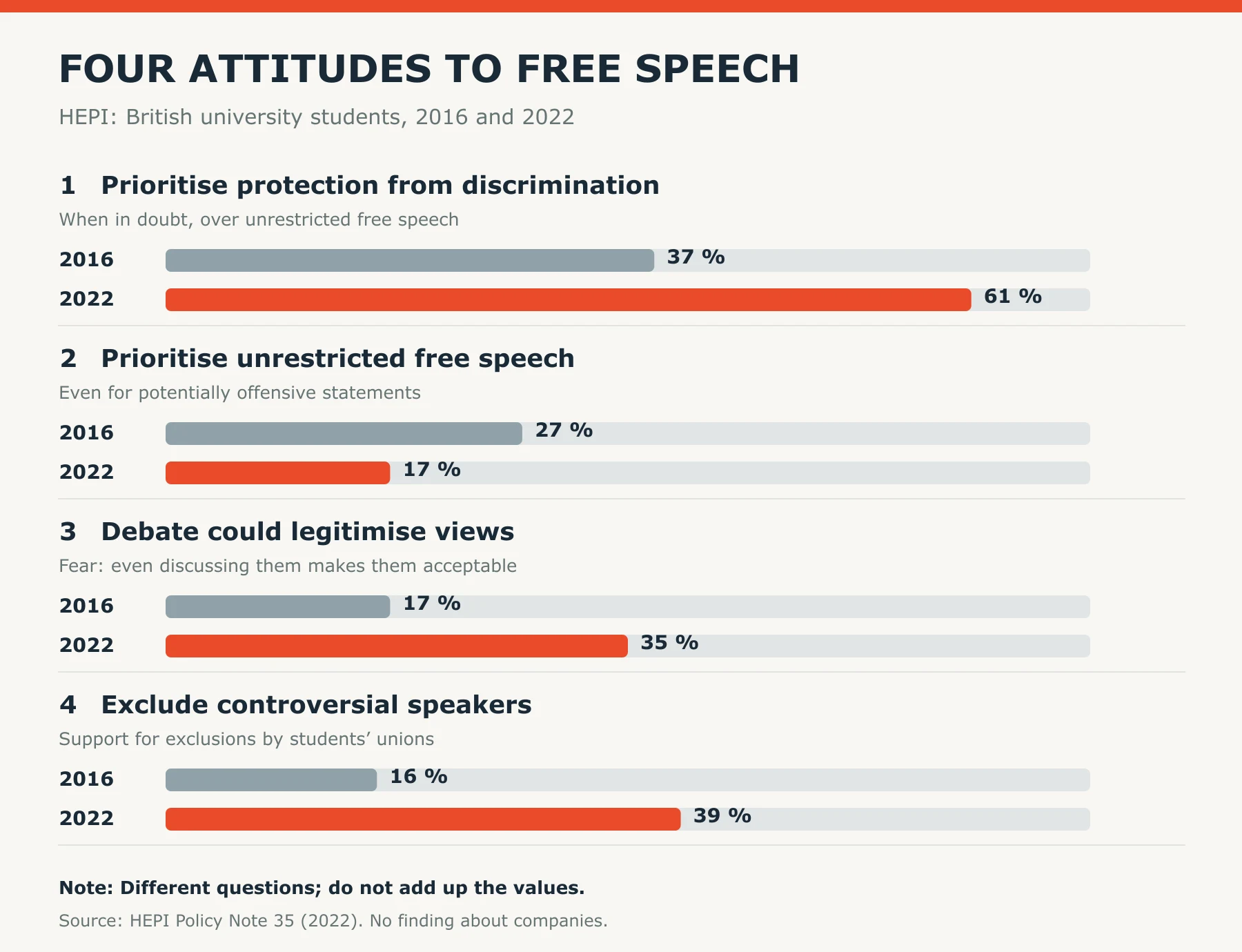
This observation cannot simply be dismissed as a personal sensitivity. A British study by the Higher Education Policy Institute (HEPI) surveyed university students in 2016 and 2022 on freedom of expression and protection from discrimination. The surveys used largely identical questions. The answers show clear shifts.
The four percentage comparisons relate to different questions. The first two values describe two answer positions on the same trade-off question. The other two values come from separate questions.
What the four positions mean in concrete terms
1. Protection from discrimination over unrestricted freedom of expression: from 37% to 61%
More and more of the students surveyed were in favour of giving protection from discrimination greater weight than unrestricted freedom of expression when in doubt.
2. Unrestricted freedom of expression despite possible offence: from 27% to 17%
The proportion of students who prioritised unrestricted freedom of expression even when others might take offence at statements declined.
3. Even discussing problematic views could legitimise them: from 17% to 35%
More than twice as many students in 2022 as in 2016 held the view that a public debate about, for example, sexist or racist views could in itself help make them appear socially acceptable. This does not mean that the respondents themselves support such positions. Rather, they fear that the discussion alone lends these positions an undesirable legitimacy. What was measured was this fear, not an actual effect of the debate.
4. Exclusion of controversial speakers: from 16% to 39%
Significantly more students were in favour of students' unions being allowed to exclude speakers whose statements might cause offence to others.
This is not proof that young people in general no longer want discussion. The study captures the opinions of British university students on specific questions of university policy, not the behaviour of employees in companies. But it makes visible a tension that I know from my working life: where avoiding hurt becomes the overriding criterion, the right to factual dissent can come under pressure.
In project management, this tension becomes dangerous when professional criticism is no longer examined on the basis of its evidence and consequences, but primarily on the basis of its emotional impact. The task of leadership is precisely not to tolerate discrimination. It is to protect people and at the same time to enable open, respectful controversy about risks, facts and decisions.
Source and context: HEPI, Nick Hillman, "You can’t say that!", Policy Note 35, June 2022, pp. 1, 4 and 5. Respondents were 1,006 students in 2016 and 1,019 students in 2022 in the United Kingdom. The figures are rounded survey values. A further HEPI survey from November 2025, published in January 2026, shows a more nuanced picture: broad support for the principle of free speech alongside support for individual restrictions. The 2016/2022 data therefore do not support an unqualified statement about further developments up to the present day.
False harmony conceals symptoms. The causes remain.
A typical pattern can be shown using a fictitious project committee: the plan is ambitious, the dependencies are unclear, a partner's ability to deliver is in doubt. Everyone knows the risks. Nobody wants to be seen as difficult in front of executive management. The minutes record that the participants agreed on the next steps. The risk remains unaddressed.
Three months later, escalation can no longer be avoided. Then come the calls for new controls, more workshops and better feedback management. But the fundamental problem was never a lack of forms. What was missing was permission to work through a factual conflict in good time and to demand an accountable decision.
In this way, symptoms are managed while the cause persists: unclear accountability, missing decision paths, fear of losing face or leadership that confuses agreement with loyalty.
A mature conflict culture is no licence for harshness
Research on psychological safety is often misunderstood. It does not call for a conflict-free environment. Its core is that people can ask questions, admit mistakes and disagree with an idea without fear of being personally belittled. Studies likewise distinguish between task conflicts and relationship conflicts: arguing about an assumption is something different from attacking a person.
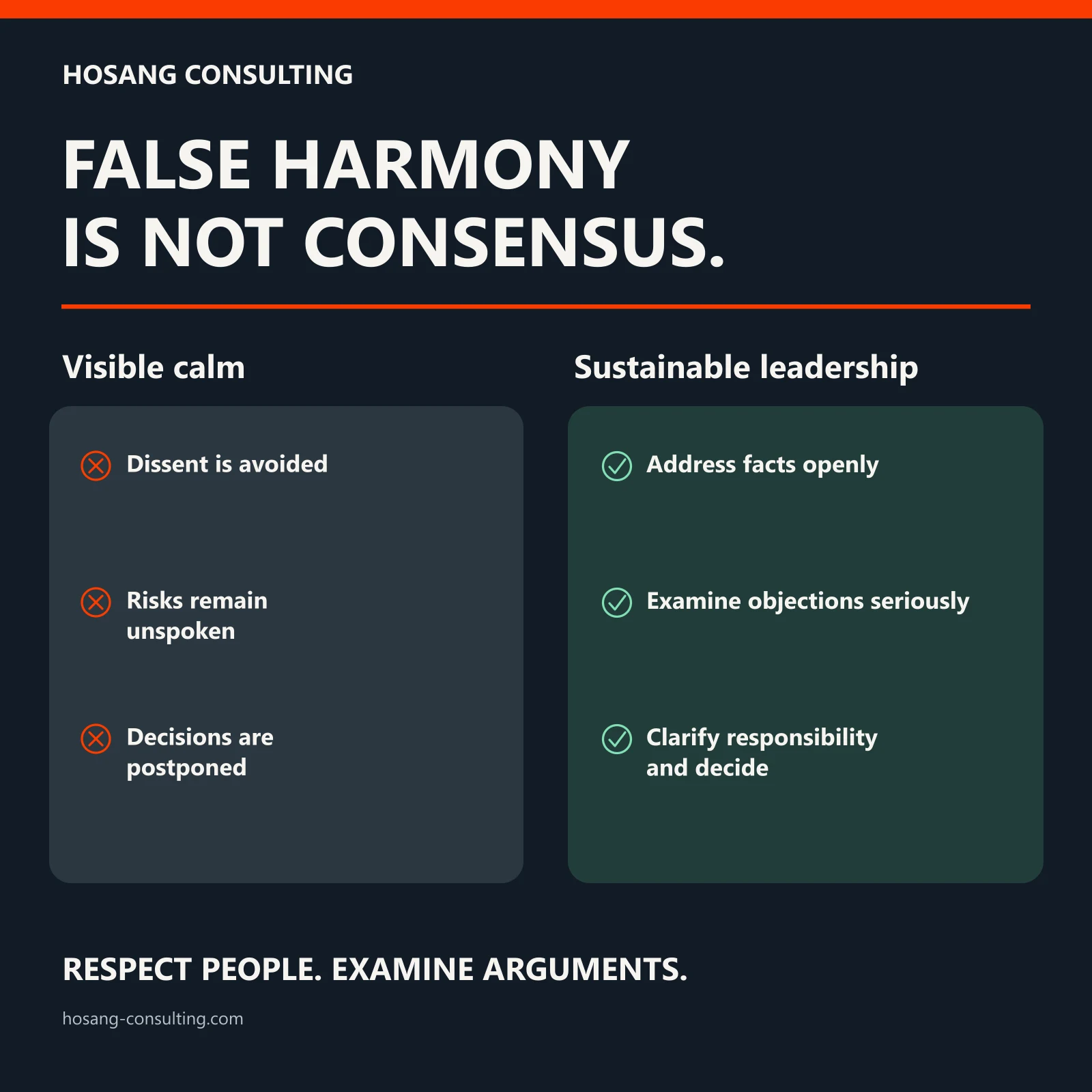
This is the decisive dividing line. Anyone who explicitly protects critical questions also protects people. Anyone who only protects harmony leaves people alone with the consequences of bad decisions.
A team does not have to agree on every point. But it must be able to examine differing assessments openly, make a decision and then implement it together.
What I specifically expect in projects
First: we distinguish between observation, interpretation and being personally affected. A risk is discussed as a matter of fact with traceable assumptions.
Second: dissent is given a fixed place in reviews and decision-making bodies. The question is asked explicitly: which professional counter-position are we still missing?
Third: whoever decides is named. A disagreement does not end in another workshop, but in a documented decision, an open review task or a reasoned escalation.
Fourth: we measure not only the mood, but also the quality of decisions. Risks addressed early, revised assumptions and timely course corrections are key signals.
Fifth: we protect the dignity of those involved and at the same time demand intellectual honesty. Criticism of the argument is welcome. Personal disparagement is not.
The real leadership failure is the conversation that never happens
A culture without visible friction can become expensive. It may produce pleasant meetings and, at the same time, unclear accountability, late warnings and decisions that nobody really stands behind. The academic discussion has a term for this: organisational silence.
Project management is therefore not the art of sending everyone out of the meeting room satisfied. It is the responsibility to bring together different interests and insights in such a way that clarity, decisions and impact emerge.
Not every disagreement has to escalate. But every significant disagreement must be workable. The decisive question is not: was the meeting harmonious? But rather: what truth were we able to speak today that will save us from a mistake tomorrow?
Sources and further reading
Higher Education Policy Institute (HEPI): Nick Hillman, "You can’t say that! What students really think of free speech on campus", Policy Note 35, 23 June 2022.
HEPI: Nick Hillman, "Are students still woke?", Policy Note 68, 15 January 2026. The more recent survey describes a more nuanced picture and does not allow a linear extrapolation of the 2016 to 2022 values.
Amy C. Edmondson and Michaela J. Kerrissey: "What People Get Wrong About Psychological Safety", Harvard Business Review, 2025.
Morrison and Milliken: "Organizational Silence: A Barrier to Change and Development in a Pluralistic World", Academy of Management Review, 2000.
"When Task Conflict Becomes Personal: The Impact of Perceived Team Performance", 2017.
Hosang Consulting: "Why projects end in paralysis", 2026.
Editorial note: The examples from project practice are based on the author's personal assessment. The project committee described is fictitious. The HEPI figures relate to British university students, not employees in companies.